Skip to content

Blog

Journal Archive

Essays, stories, and updates from Corie Adjmi.

March 10, 2015

Writing and Rejection

Thankfully, my novel has been getting good feedback. Really good feedback. But I got a rejection email this week. Okay, I’m being dramatic. But that’s how it feels sometimes. Nobody likes rejection. And yet in the writing world, you are told, again and again, how getting rejected brings you one step closer to publication. In On Writing, Stephen King says, “The nail in my wall would no longer support the weight of the rejection slips impaled upon it. I replaced the nail with a spike and kept on writing.” Click on this link to see a list of best sellers rejected numerous times before they made it. It is unbelievable to think that Gone With The Wind was rejected 38 times before being accepted. The novel went on to sell 30 million copies. Harry Potter and the Philosopher’s Stone by J.K. Rowling received 12 rejections in a row before being accepted. The Harry Potter series set records as the fastest-selling books in history with combined sales of 450 million. And more recently, The Help was rejected 60 times before getting published. It has become a worldwide best-seller. It’s always tough when a rejection letter arrives but there is something to be learned: a building of muscle, gained knowledge, a repertoire of experiences that brings you, little by little, closer to publication. This is my favorite personal rejection story. I refer back to it when I feel discouraged. As recently as five years ago, short stories were submitted for publication to literary journals by “snail mail”, a term referring to mail delivered by the U.S. postal service. In my Brooklyn home, there is a mail slot in the front door and every Saturday the mail is delivered at the same time, which coincides with when my family eats lunch. When the flap on the mail slot hits the frame, it makes a loud clang. For years, every time I heard the sound, I jumped up from my seat at the table and ran to the door to retrieve the mail, hoping I’d get an acceptance letter for any of the number of short stories I’d submitted. More often than not, I found rejection letters, which is not uncommon in the literary world. Sometimes the rejection is standardized, and on sliver of paper no thicker than a pen, and sometimes there is a note, cordial and encouraging, but nonetheless, a rejection. Now and then, there was an acceptance letter and that intermittent reinforcement, just like a win at the slot machine, kept me hooked. And so today, even though correspondence with literary journals happens through email, when the mail slot clangs against its frame, I have to stop myself, a Pavlovian response, from running to the door. The craving for feedback from editors and the desire for publication is intense. And so one summer when we moved to New Jersey, and had our mail forwarded, it was quite distressing when all of it was lost, and I didn’t receive a single piece of mail for over six weeks. I worried that my dreams of publication would go unrealized if my response letters were gone for good. All that hard work: the writing and editing of the story, targeting appropriate journals, preparing cover letters and stuffing envelopes- all of it- a waste of time. When the mail was finally found, my husband picked it from the post office. He brought it home in a black trash bag, the mail filling the bag like fallen leaves. I set the bag on the kitchen counter and separated the bills, newsletters and invitations from the self addressed stamped envelopes that I’d sent to editors around the country. I opened the letters, hopeful. Note that it was unusual to receive all these responses at once but because of the mail mishap, I got this particular view. In response to a specific short story, I got three replies, and I lined them on the counter next to one another. 1. A standard rejection letter. 2. A note saying my short story had potential and that if I was willing to do significant revisions, I could re-submit the story. 3. An acceptance letter. One story. Three points of view.
"The Dress" And Letting Go of The Need To Be Right

March 3, 2015

"The Dress" And Letting Go of The Need To Be Right

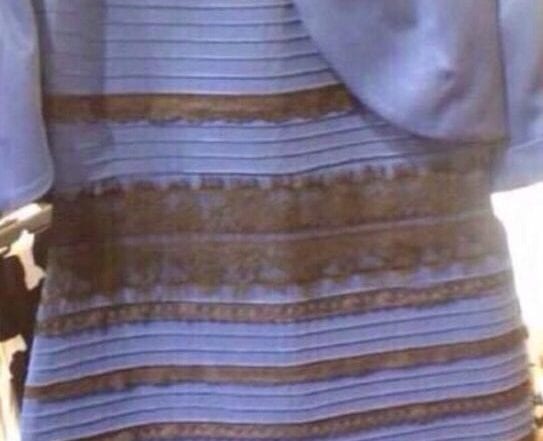
I’ve seen it over and over again: The need to be right. It’s a relationship killer. It affects marriages, friendships, co-workers and heads of countries. I saw it, the needing to be right problem, brewing this past weekend over “The Dress”. Husbands and wives, brothers and sisters, parents and children vehemently fighting over if “the dress” was blue and black or white and gold. It was actually comical how intense people got in their efforts to convince others to see what they saw. My own family had a group chat going for most of Friday. What started out as funny turned well, here it is. You decide. Note: Text messages have been edited for clarity reasons and to protect those in my family who can’t spell, and those who don’t care about grammar: text message or not. 10:21am Friday morning, I got this from my oldest son. Let's call him Son#1: What color is this dress? My husband answered: Is this a trick question? It’s blue and black. Daughter #2: It changes. It was white and gold but now it’s blue and black. Son #2 said he saw blue and black; but his wife saw white and gold. He said they fought about it all night. I wrote: Blue and black. And to the gold and white people- what are you talking about? Son #1 sent this updating us on the picture that had gone viral and the story behind it that had the nation’s attention. *************************** My husband works in the fashion business and he worried about his design team. What if they had color issues? Son #1, who works in the family business with him, was about to go into a design meeting. He assured my husband he would get to the bottom of this. Daughter-in-law #1, who is a nurse, sent a very long and scientific text explaining that our retinas have rods and cones and she used phrases like subtractive mixing and additive mixing, and I knew that more than half of my family would not bother to read her text. Our family discussed “the dress” all day via group chat, today’s version of family bonding. I was excited because it was Friday; and so, I imagined the prospect of a Friday night dinner conversation about perspective and perception, human complexity and the human condition, a conversation with more depth than our usual dialogue, like is pink salt better tasting than kosher salt? And are the mashed potatoes on the table really mashed potatoes or is it really mashed cauliflower? And how nobody in his or her right mind would ever prefer cauliflower. So I pushed my agenda and wrote: This is craziness. What an interesting take on perspective. There was no response to the seed I’d planted. The next text was from Daughter-in-law #2: It’s white and gold!!!! We were all flummoxed, but Son #1 said it best: Major bug out. Daughter #1 chimed in: You guys are nuts. It’s blue and black. (Reader: I presume you see my family’s sincere interest in understanding one another’s point of view.) Son #1 sent this picture. What do you see now? Son #3 wrote: Those are obviously 3 different dresses. Daughter-in-law #2: I see white and gold in all 3!!! Daughter #2: No you don’t!!! Then the real fun began… Daughter-in-law #2 raised the stakes: I feel sad for all you blue and black people because the dress is white and gold. Fact. (Now that’s tolerance.) Son #2 (and the above daughter-in-law’s husband): You’re lying. You don’t see white and gold on the last one. Daughter #1: I feel sad for you white and gold people. These all 3 are blue and black! What else are you missing out on in the world? What color are blueberries to you? Daughter-in-law #2: No, I feel sad for you. (Angry emoji face). I can’t believe you see blue and black. I thought differently of you. I guess happy people see lighter things. (Smiley emoji). Good luck in life black and blue people. Daughter #1: So happy person, what color do you see? Daughter-in-law #2: Forgot who I’m debating with. Gonna need a little help. (She summoned son #3, my white and gold seeing son.) He sent this… Are you blue and black people seeing an evil Satan baby wearing black? Then we got this: Then this arrived: We continued to debate throughout the rest of the day. While there were a couple of digs here and there, there was plenty of laughter. I can’t help but think there’s something important to be learned from “the dress” and the dialogue it sparked. No matter how logical the reasoning, the fervor of the argument, the force of the claim, those who saw gold and white could not see black and blue no matter how much the black and blue people wanted them to, and visa versa. Wars happen, divorce happens, often because people need to be right. But what if there is no right? Or more precisely, depending on how you see things, what if both sides are right?

Gone Girl No More

February 24, 2015

Gone Girl No More

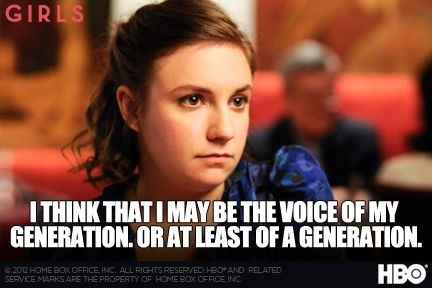
There’s a reason the picture of me on my About Page was blurry. It’s because I couldn’t be bothered to get a good photograph of myself. And so I used my cell phone to take a picture of only me from a group photo of twelve friends. I meant to get a headshot, I just wasn't making it a priority. But when the North American Review wanted to include a photo, along with my bio, when they published my essay, On Writing and Distractions, on their blog, I felt ridiculous sending them my blurry picture. I’d talked to three photographers and got prices for headshots and yet I hadn’t scheduled a sitting. What was stopping me from getting my picture taken? At first, I thought I was just being lazy, but then I realized it was something more. I came to this: I wasn’t taking my career, or myself, seriously. In second grade, I wrote plays. Not only did I write plays, I gave myself the lead part. I was boisterous and confident. That year, on my report card, my teacher wrote, Corie is a flirt. I was humiliated. My teacher reduced the relationships I had with the boys in my class to flirtatious, instead of acknowledging that I was both writer and director of my own plays and that I was in charge. I was the Lena Dunham of my generation! In fifth grade, my teacher assigned me the role of “The Heart” (underscoring my compassionate nature, a much prized quality in girls) in our, not written by me, school play. It was a no-speaking part. By the time I got to middle school, I no longer performed in plays. Somewhere along the way, I faded. In the Wall Street Journal essay, What ‘Boyhood’ Shows Us About Girlhood, Dr. Sharon Marcus and Dr. Anne Skomorowsky point out how Samantha, the young girl in the film, at first, dominates, teases and outperforms her brother, Mason. Samantha is outspoken and confident. She challenges her controlling stepfather. In adolescence however, Samantha begins to “disappear.” She speaks with uncertainty and develops a nervous laugh. Mason, on the other hand, develops nicely. He learns to speak with assurance. He is full of ideas. At school, Mason is asked questions like: What can you bring to it that nobody else can? He is encouraged to express his individuality. His father tells him, I believe in you. And Samantha is asked: Do you want to be a cooperative person, who is compassionate and helps people out? Or do you want to be a self-centered narcissist? Gillian Flynn, the author of the novel Gone Girl, explains that she wrote the book to counter the notion that women are "naturally good" and to show that women are just as violently minded as men are. I think Flynn tried to do more than that. Amy, the female protagonist in the novel, says “Nick will spend the night of our anniversary buying these men drinks, going to strip clubs and cheesy bars, flirting with 22-year-olds…” It seems clear that no woman would appreciate that behavior from her spouse and yet Amy says condescendingly about herself, “I am being a girl.” When did being a girl become a bad thing? After a few years, in an unfulfilling relationship (not a spoiler since you learn this on page 24) Amy, educated and competent, literally disappears, a metaphor for Amy losing herself, figuratively unseen. Pop culture shines a stark light on girl culture and how girls are encouraged to take a backseat to boys. We learn to make ourselves less visible. Yes, I was raised with Carol Brady as a role model, and yes it is true things have changed for girls to some extent, but not enough. There’s only one way around this issue, and that’s through it. Girls can’t be afraid to be seen. I ended up booking an appointment for a headshot shortly after coming to the realization that I should start taking myself more seriously.

This is What Happens When You Combine Therapy and a Family Dinner

February 17, 2015

This is What Happens When You Combine Therapy and a Family Dinner

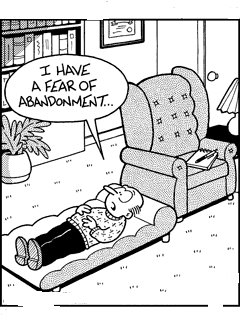
We sat at the dinner table, my husband and two of our children. My husband was joking around when he said, “you’d still be in the bayou if it wasn’t for me.” (By bayou he meant New Orleans.) I didn’t say anything. “And you wouldn’t have anything to write about.” (It’s true - he’s given me plenty of heartache. Oops- I mean, material.) “What would you be without me?” I played along. “I can’t imagine what my life would be like without you.” “A lot less therapy,” my son said. We had a good laugh over that one. “My poor mother,” I said, “she thought it was because of her.” But the truth is I sought out therapy because of me. I’m a believer. It’s simple really. I’ve learned so much. Like the time my typically good-natured 14 year-old son was fighting with all of his siblings and my therapist said that his bad behavior was making it easier for him to separate from our loving family. She assured me that what he was doing was developmentally appropriate. With this understanding, I engaged with him in a way that was sympathetic, not punitive. Like the time I learned that while my husband could be overly assertive, it was my job to find my voice and practice agency. Like the time a friendship veered off-course, and I discovered I couldn’t change anyone but myself. What I’ve learned in therapy has been invaluable. I treasure every insight realized and every nugget of information acquired. And it's good to know, when all else fails, in the words of Robin Williams, according to Freud, "if it's not one thing, it's your mother."

Painting with Purple Crocodile and Black Leather

February 10, 2015

Painting with Purple Crocodile and Black Leather

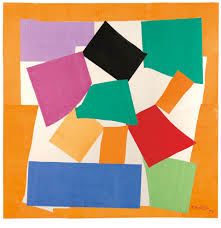
My grandmother, Freda, brushed her beauty parlor- coiffed hair at a gilded light-blue vanity table. She dabbed her wrists with Bal a’ Versaille perfume and never left her apartment without a full-face of make-up. She painted her eyelashes with electric blue mascara and her fingernails, bright red. I care about what I look like, I do. But for most of my adult life, I couldn’t care as much as my grandmother did. Believing it to be a waste of time, not to mention narcissistic, I couldn’t be bothered to change my jewelry, or my purse, to match my outfit. Plus, more often than not, these acts led to calamity. I misplaced jewelry. I forgot my wallet at home. The truth is that as a young adult, I devalued fashion and judged how much energy my grandmother put into her looks, always calling attention to herself. I don’t anymore. I respect it and wish I had the many colorful crocodile purses or Gucci silk blouses she gave me. What she wore was how my grandmother expressed herself. This was her art. She was the canvas: every splash of color, how every fabric draped, the clanking of bracelets on her arm. My grandmother didn’t have the opportunity to attend NYU’s art program or Bread Loaf Writers’ Conference, as I did. She did what she could with what she had. She wore colorful, long, flowing skirts and called herself a gypsy. Other days, strutting around New York City, well into her eighties, she wore black leather pants. Last weekend, I went to the Museum of Modern Art and saw Matisse: The Cut-Outs exhibit. Matisse referred to his process as painting with scissors. And it occurred to me that my grandmother painted with clothes. For texture: a snakeskin belt, a fur coat, a silk scarf. And color: purple was never just purple. It was aubergine; and on her palette there was milk white, canary yellow, coal black and robin egg blue. For as long as I can remember, while I adored my grandmother, I thought when it came to fashion, we were completely different. Rebelling, I undervalued what was in vogue, attempting to carve out my own identity. But when we make decisions based on unconscious motivations, we cut ourselves off from our true selves. “Until you make the unconscious conscious, it will direct your life and you will call it fate.” – Jung. I have come to appreciate fashion, and to see it as art; but for many years, I reduced my grandmother to a mannequin and saw her belief system as flawed. I went the opposite way, finding fashion frivolous and unnecessary. But in doing that I was being controlled by my family’s value system around beauty just as completely as if I had become a fashionista. The Matisse cutouts are made up of positive and negative shapes. The positive space is generally considered the subject and the negative space is not the subject. BLOG- MATISSE WOMAN The negative space is equally as important as the positive space; and paying attention to the negative space can have a surprising effect on a work of art. In studying the Matisse cutouts at the museum, I came to see what’s conscious in us as positive space; and what’s unconscious as negative space. It’s in exploring both, what’s conscious and unconscious, that we come to know who we really are and what we really want. I don’t have to care about fashion the way my grandmother did; but I don’t have to not care either.

February 3, 2015

Cheaters Sometimes Prosper

I cheated. Once. I was in 11th grade. I didn’t know I had an American History test, and when I walked into my classroom and realized I had one, I panicked. I had an “A” average that I wanted to keep. Suffice it to say, there was a part of me that felt justified. I rationalized that if I had known about the test, I would’ve studied, and done well. And not knowing about the test was sort of, kind of, not my fault. I had to make a quick decision: cheat or don’t cheat. I hid my stack of notes under my test and thinking my teacher oblivious, I chose: cheat. Of course, I was caught. And the humiliation and shame I felt was way worse than if I had failed the test. But usually, when someone decides to cheat they’re not imagining getting caught; they’re fantasizing they’ll get away with it. What I didn't contemplate at the time was how I would feel after the test, knowing I’d cheated to get a specific result. I’m not a football fan. I don’t like many things about the sport, in particular, aggression, but also the issues presently circling the game: domestic violence, sexual assaults, player concussions and higher rates of dementia. However, I will say that Deflategate (the scandal determining if the Patriots intentionally deflated balls, which makes them easier to handle) has caught my attention. I guess what I’m thinking is that if I felt guilty about cheating on a test in 11th grade, what were the Patriots thinking? And now that they've won Super Bowl XLIX, how does the team feel? It’s not confirmed that the balls were deliberately tampered with but it seems evident that they were. And I’m wondering why a winning team would bother. After all there are consequences for getting caught. Besides fines and penalties, your team’s integrity is questioned and good old-fashioned American values like sportsmanship and honesty are diminished while money, glory and winning take center stage. What ever happened to: You win some, you lose some. And It doesn’t matter if you win or lose; it’s how you play the game? According to Stephen Mosher, a professor at Ithaca College who studies sports ethics, “It’s certainly accepted as part of the culture that you game the system as much as you possibly can, and if you don’t get caught, it ain’t cheating.” Maybe it’s that mentality that has given us a slew of scandals to consider, starting with Watergate, the political scandal in 1972 that forced President Nixon to resign rather than be impeached. The Nixon administration was accused of cheating and then lying after breaking into Democratic National headquarters. The suffix “gate” has come to be used many times since 1972, especially, but not exclusively, in regards to football scandals. To name a few, there has been Bountygate, a scandal in which members of the New Orleans Saints were accused of paying out bounties for injuring opposing team players. Spygate refers to the incident when the New England Patriots were disciplined for videotaping sideline defensive signals from New York Jet coaches. And now there is Deflategate. So what’s the drive? Is it money? Is it fame? Is it power? Is it winning? Tom Brady, led the Patriots to victory in Super Bowl XLIX, and is now a 3-time winner of the Super Bowl Most Valuable Player award. The thing I don’t understand is that how you play the game actually does matter. You might achieve a victory; but if you cheated to accomplish that goal, did you really win? I’d say if your goal is to be illustrious, at least in this country, the answer is yes. We might want to think about that.

Pouting Face Emoji

January 27, 2015

Pouting Face Emoji

Emojis really bug me. I don’t now why; but they do. They lack imagination. They are uninspiring. But mostly, they are annoying. The biggest problem is that I can’t see them on my cell phone. They are so tiny I need a magnifying glass. These smiley faces do not make me happy; in fact, they are infuriating. And my husband won’t stop sending them to me. How can we communicate if I can’t decipher what he’s saying? Is the red mark on the smiley face puckered lips or a tongue sticking out? He can’t stand sitcom laugh tracks; and I used to wonder how a person could get enraged from laughter. Maybe we’ve been married for too long, but I get it now. Emoji smiley faces are maddening. Don’t get me wrong; I’m a huge supporter of the original 1970’s smiley face. But there is something about this emoji that makes my skin crawl. I have nothing against ancient cave drawings, hieroglyphics or even Morse Code; but if I see one more dancing girl, I will have come up with the perfect reason to use the gun emoji. I admit I've added :) and :( to some recent messages; but I have no reason to use the man wearing a turban, a syringe with blood or two boys holding hands. Who uses this emoji? In what context would it be applicable to send this? I guess a teenage boy who was coming out could send that emoji with a text message that said, “Hey, Dad, guess what?” Emoji is a computer language that originated in Japan. Pictures were created so people could send a lot of information through a small amount of data. But how is that necessarily beneficial? Don’t tell me if you were just dumped by the love of your life this broken heart would suffice to express how you felt. Did you know that in addition to a broken heart emoji there is a green heart, a red heart, a blue heart, a yellow heart, a purple heart, a growing heart, a beating heart, a sparkling heart and a revolving heart? All of these symbols rub me the wrong way because they are cartoonish and child-like. They are one-dimensional and flat. I don’t have anything against cartoons per se; but emojis are not smart like Family Guy or sophisticated like The New Yorker. Maybe what’s happening to language is no different from when, almost 300 hundred years ago, “will not” turned into “won’t” and “you are” turned into “you’re”. Lexicographers of the time objected. I certainly don’t want to be left behind, out of date. So, maybe I’ll come around. I’ve started to use exclamation points excessively in my text messages even though I was schooled to use them sparingly. But today, in a texting world, it’s what’s expected. When you don’t, you come across as dull and unfriendly. Note the difference: Come over. And… Come over!!! Language has depth and dimension. Words convey meaning, complex, multi-faceted thoughts and emotions that are layered and fluid, which arouse our five senses; sound, taste, touch, smell and sight. Emojis don’t do that. They may be quick and easier to use than words; but they are as sensual as a kid’s stamp kit. The purpose of emojis is to allow you to get more bang for your buck, so to speak; and while sometimes quick and easy is preferable, not everything is better abridged.

Draw, Sing, Dance, Shout from the Rooftops: Je Suis Charlie

January 20, 2015

Draw, Sing, Dance, Shout from the Rooftops: Je Suis Charlie

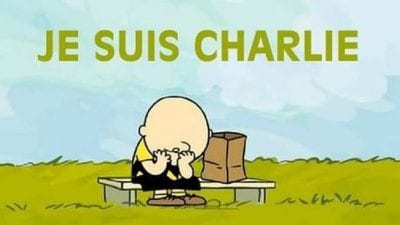
I’m writing this post because I can. I have that right. And yet, I have to admit, I’m scared. I’m scared to google: Charlie Hebdo. I’m scared to go to a kosher supermarket, a synagogue, a yeshivah. I’m not scared to the point where I won’t actually do those things; but I do them with forethought. For months after 9/11 the only way into Manhattan was by subway. As the Q train sped across the Brooklyn Bridge, I put my hands over my face, my head in my lap and prayed. My friend, Susan, took one look at me and said, “I don’t believe what I’m seeing. Are you crazy? What do you think is going to happen?” I didn’t know. What I did know was that on the morning of 9/11, while phone lines were still intact, I called my husband, hysterical. I told him I was watching TV and that a plane had flown into the World Trade Center. I said the building was going to go down. Even as the words came out of my mouth, I didn’t really believe what I was saying. My husband told me I was being ridiculous, that the building would not go down. But it did. Charlie Hebdo is a French satirical weekly newsmagazine named after the American Peanuts character, Charlie Brown. The magazine is known for its provocative cartoons mocking political leaders and religious extremism. All extremism- Catholic, Jewish, Muslim. “Charlie” is pro-freedom and believes that the best cartoons make people laugh and think. Extremists don’t want people thinking independently. Education is like kryptonite to extremists. (See: Teach Children and Change the World.) It’s true that Charlie Hebdo cartoons have been inciting havoc for years, and after seeing images, I agree that some are racy and even disrespectful; but in a free society, if you don’t like it, you don’t have to look. You can boycott or protest- you can write, draw, dance, march, sing your opposing point of view; but you can’t murder. Voltaire, a French philosopher and advocate for freedom of religion and freedom of expression said, “I hate what you are saying, but I shall fight so that you are able to say it.” Friday night, at our Shabbat dinner table, my family talked about the killings at Charlie Hebdo, we talked about the murders at the kosher supermarket and we talked about the march in Paris for solidarity. I brought up that in response to the supermarket incident, a women commented online, “Why should anyone have sympathy for a group that thinks that regular food out of the regular grocery store is unfit to eat.” Thankfully, someone wrote back, “That is an incredibly racist and ignorant comment.” But the questions we are left to grapple with are: How do we deal with such hatred and naivety? And how do we fight terrorism while protecting our civil liberties? Before the massacre at Charlie Hebdo, the magazine was in financial trouble and did not have a huge following. Weekly, the magazine printed 60,000 copies with less than half being sold. But since the massacre, one million copies of the first issue were planned. It was then increased to three and later five million copies. In the end, seven million copies were printed. Ironically, just like with the film The Interview, terrorists have called worldwide attention to, and spurred interest in, subjects that might have gone less noticed. And as a result of their heinous crimes, we have joined together, and in that solidarity there is commitment and strength. Who knows what will change, or if anything will change at all; but every small act matters, and if the terrorists hadn’t attacked Charlie Hebdo, I probably wouldn’t be writing this post, mostly, because my dedication to freedom of speech wouldn’t have been on my mind; but also because if I didn’t address my own fears in writing this, terrorism would be working. While I’m not as brave as the editor at Charlie Hebdo who said after an attack in 2011, “I’d rather die standing up than live on my knees,” I embrace his sentiment, and this post is my banner, my contribution to the fight. I am freedom. I am Charlie.

Why Are So Many Marriage Essays Going Viral?

January 13, 2015

Why Are So Many Marriage Essays Going Viral?

I want my marriage essay to go viral. Why You’re Not Married, written by Tracey McMillan went viral. Marriage Isn’t For You, written by Seth Adam Smith went viral. It has over 30 million views! Both Tracey and Seth have book deals. Tracey was on Oprah! At the time of his post, Seth had been married for only a year and a half. Tracey’s been married 3 times. Okay, I’m happy for them. Really I am. And I’m not suggesting they don’t have anything to share or teach, but come on—I’ve been married for 32 years! If staying together is the goal (which I guess is questionable as far as goals go) I’ve got the credentials. I’m the one who should have a marriage essay read by millions. I should be on Oprah. I mean really, where are the people who’ve been in long-term marriages? They’re actually not on Oprah. Exception: Harville Hendrix, author of Getting the Love You Want. He’s great and his book is awesome. He’s been on Oprah a number of times, but we need more role models. Good ones. And fast because marriage is getting a bad rap. People are choosing not to get married at all, as in NEVER. Or they talk about first marriages like it’s a bachelor degree, something they will eventually move on from in order to pursue a second marriage, their graduate degree. There are some misconceptions I’d like to clear up: 1. Long-term marriage doesn’t mean 10 years. Ten years is a phase, a bleep in a life, like adolescence. Long-term means you go through all the developmental stages together: playing house, raising children, growing old, facing health issues, dying. A lifetime. 2. A partner is not someone who stays home, changing diapers and cooking dinner, while you pursue every dream you ever had. 3. Respecting each other’s differences does not mean you are awesome when you don’t change the music station when The Carpenters are on and you prefer Eric Clapton. (Okay, full disclosure-—that’s my house.) 4. Monogamy is a full-time job. If you do it part-time there is less insurance and fewer benefits. Look, I’m not judging. My philosophy is that everyone should be happy. And what would make me really happy is for my marriage essay to go viral! Here's a question: If marriage is on the decline, why are essays with marriage as a keyword wildly popular? Why was Men Are from Mars, Women Are from Venus on the topseller list for 121 weeks? Why is the book, The Five Love Languages: The Secret to Love That Lasts a hit? Why are we watching Dr. Phil? Broken Nose, Broken Marriage. Save My Marriage, Save My Life. And why when I saw a friend on Facebook had taken a test that told her who she was married to in a past life was I intrigued? I shouldn’t have cared, but she got Jim Morrison. I wanted Jim. I thought about taking the test, but I worried I’d get Barry Manilow. I had to know. I took the test and got John Lennon!! I couldn’t have been happier. He’s a peace-loving artist. And he’s so cool. You’d think I had better things to do with my time like write a really great marriage essay, one that would go viral. But no. I needed to know who my fantasy husband from a different life was. Here’s what I think. Even though marriage is on the decline, for many of us, a fascination exists. There are things we want to know about relationships: how to make them last, how to make them better, how to fix what’s broken. Aha! The “in” for my marriage essay: When Your Marriage Breaks. Maybe it’s physiological, or sociological, or biological, or historical, but there is something in us that yearns to unlock the mystery of marriage. We want to get it right. Granted, I’ve never been on Oprah, but here’s my marriage advice: Relationships have their rough spots and you have to figure out how to navigate those moments like jujutsu. For example: when your spouse stops listening to you when you talk, start writing. And pray it goes viral.

Brave New Me

January 6, 2015

Brave New Me

Growing up, I detested Star Trek and anything futuristic. I had no interest in science fiction, and to this day have never seen Star Wars. In high school, because it was assigned, I read Brave New World and Nineteen Eighty-Four, but left to choice, never saw The Empire Strikes Back, Return of the Jedi or The Matrix. Science fiction is a genre of fiction dealing with science and technology, space travel, time travel, parallel universes and extraterrestrial life. And truthfully, for the most part, those things didn’t interest me. I’m not one for dramatic change, and science fiction forced me to participate in scenarios that required a lot of imagination, and even if only for the duration of a film, acceptance of a life that looked way different from the one I was living. I didn’t want to contemplate an existence with aliens or a future bleak with Big Brother. Those things, and Spock’s ears, frightened me. Turns out, I was right to be frightened because science fiction movies and books have predicted our future. "Brave New World" by Aldous Huxley portrayed a world in which people escaped through the use of mood-enhancing drugs called "soma". "By this time the soma had begun to work. Eyes shone, cheeks were flushed, the inner light of universal benevolence broke out on every face in happy, friendly smiles." Huxley wrote about mood- altering drugs in the 30’s, years before antidepressants became prevalent. And in Nineteen Eighty-Four (1948), written by George Orwell, government control was questioned. Orwell described a future where "Big Brother," knew exactly what you were doing and when. "There was no way of knowing whether you were being watched at any given moment. How often, or on what system…It was even conceivable that they watched everybody all the time." With surveillance cameras, computer hacking and information forever stored in the cloud that concept is not so far-fetched today. As a young girl, I couldn’t have imagined a future world without landline phones, encyclopedias or marriage. And yet those things are either already obsolete or on there way to being outmoded. The same way I couldn’t have imagined a world without those things, I’ll bet you can’t imagine a world without food. And yet science is taking us there. Interestingly enough the concept of not needing food was depicted in a 1973 science fiction movie called Soylent Green. I’ve never seen the film but it takes place in a dystopian future suffering from pollution, overpopulation, depleted resources, poverty, dying oceans and other problems due to the greenhouse effect. In the movie, people survive on wafers called "Soylent Green"; and as if an overpopulated, polluted, world weren’t horrifying enough -spoiler alert- Soylent Green, viewers find out at the end of the movie in a surprising twist, is made of human remains. In 2012, three young men ran into financial trouble while working on a technology startup. They needed a way to cut expenses. They found food was a problem: costly and time-consuming. Rhinehart, who was studying electrical engineering, began to think about food as an engineering problem and concluded that food was an inefficient way to get what you needed to survive. Rhinehart put his startup on hold and focused on nutritional biochemistry. He invented a potion made up of 35 nutrients required for survival, and being a bit derisory called it Soylent. He started living on it. Only. Rhinehart claimed Soylent was saving him time and money and physically, he wrote, “I feel like the six million dollar man. My physique has noticeably improved, my skin is clearer, my teeth whiter, my hair thicker.” Read: The End of Food published in The New Yorker for more details. The article describes how meals in the future will be separated. There will be meals for utility and function, and meals for experience and socialization. Liquid food has played an escalating role in diet regiments for years. We have Ensure and Muscle Milk and because of health concerns and time constraints there is juicing and green drinks and smoothies. Tim Gore, the head of food policy and climate change for Oxfam says, “The main way that most people will experience climate change is through the impact on food: The food they eat, the price they pay and the choices they have due to availability.” The New Yorker article states that Chipotle announced it might phase out guacamole due to climate change. This might be proof that Gore is right. In Interstellar, a recently released science fiction movie, humans can no longer survive on a dying planet Earth and a crew of astronauts travel through a wormhole in search of a new home for humanity. It doesn’t sound like my kind of movie but I’m reconsidering if I’ll see it. That’s what art does: it shows us who we are, and what we want. But also what we fear.

Teach Children and Change the World

December 30, 2014

Teach Children and Change the World

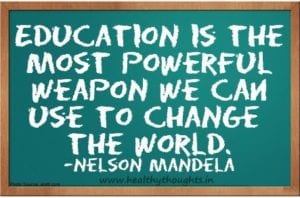
On October 9, 2012 the Pakistani Taliban shot 15 year old Malala Yousafzai in the head. She was on her school bus. On April 14, 2014 Boko Haram, an Islamic terrorist organization, kidnapped 276 female students in Nigeria. On December 15, 2014 the Pakistani Taliban killed 141 people (132 of them children) in a school in Peshawar. Terrorists understand that education corrodes extremism. Terrorists understand that education is the most powerful force to transform society. That’s why they keep attacking schools and school children. It is unthinkable and utterly disturbing. In a New York Times piece, What’s So Scary About Smart Girls? Nicholas Kristof writes, “When terrorists in Nigeria organized a secret attack last month, they didn’t target an army barracks, a police department or a drone base. No, Boko Haram militants attacked what is even scarier to a fanatic: a girl’s school. That’s what extremists do. They target educated girls, their worst nightmare.” In a more recent essay, Kristof states, “I’ve concluded that education may be the single best way to help people help themselves.” So what’s my point? Is it that… A. American leaders should know this too and should invest more in education both domestically and overseas? B. Individuals will find power in getting educated? C. Parents must educate their children? D. All of the above. Malala Yousafzai miraculously survived and is now an activist who speaks on the rights of children. She brought worldwide attention to the mission: BRING BACK OUR GIRLS after the kidnappings in Nigeria. Sometimes, I feel helpless because it seems there is little I can do. But in an effort to be a part, albeit a small part, of the solution, I support Room to Read, an organization that envisions a world in which all children can pursue a quality education, reach their full potential and contribute to their community and the world. It has been said that the most influential of all educational factors is the conversation in a child’s home. What’s the conversation at your house?

On Writing and Distractions

December 23, 2014

On Writing and Distractions

Sometimes when I write it feels as if 20 minutes have gone by when in actuality it is 2pm and I’m still in a robe. When I first started writing this unnerved me...