
February 9, 2016
A Woman's Work Is Never Done
In the Syrian Jewish community, there is a word, shatra, which means to serve abundantly, willingly and beautifully. Traditionally, this has been the highest compliment you could give a Syrian woman.
Blog
Essays, stories, and updates from Corie Adjmi.
February 9, 2016
In the Syrian Jewish community, there is a word, shatra, which means to serve abundantly, willingly and beautifully. Traditionally, this has been the highest compliment you could give a Syrian woman.

February 2, 2016
“Haha, I figured the eighteen emails just meant you were really excited!!”...
January 26, 2016
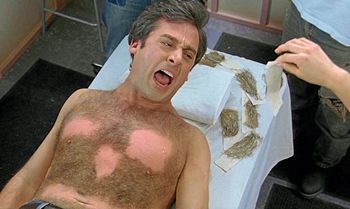
I’m the mother of three sons and I don’t usually get involved, or show much interest, when they discuss Fantasy Football; but when my son, Jack, revealed at dinner that he’d be waxing one of his legs, I got real curious...
January 19, 2016
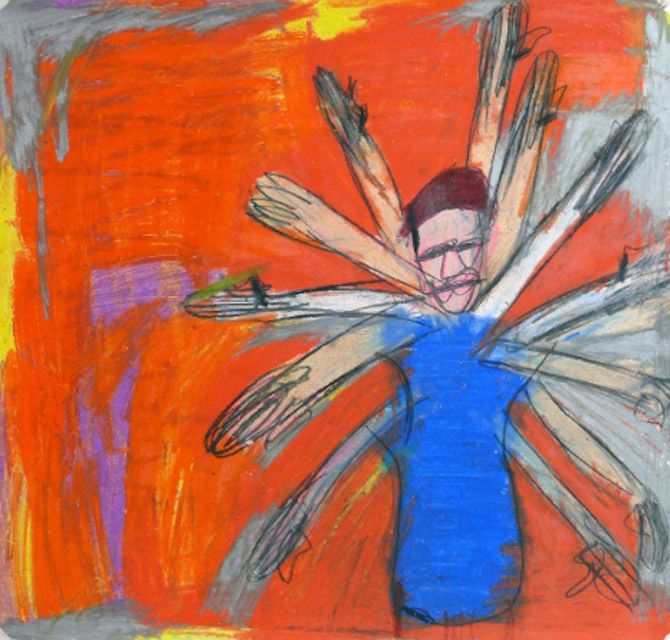
Outsider Art refers to art created outside the boundaries of official culture, outside the established art scene. I first heard the term Outsider Art about a month ago when I saw an interview on facebook. The Outsider Art Fair is this week in New York City (January 21-24) at the Metropolitan Pavilion. In a New York Times Magazine article, I learned about the Creative Growth Art Center in Oakland, California, where artists who have not had formal art education come to create. The work is considered more pure, raw, than mainstream art. Not always, but sometimes, the artists are physically or emotionally impaired. In a Huffington Post article, Priscilla Frank discusses how a policeman learned to embrace his creative side. I love this idea of self-taught art, art without academia. Maybe it’s because in the eighties, I was accepted to the art program at NYU and things didn’t go well for me there. In order to get in, I had to show a portfolio. I had to sit through a nerve-wracking interview. And when I got in, I was thrilled to be part of the New York City art community. Until I wasn’t. It didn’t go badly at first. In fact, during my first semester in the program, my drawing teacher appreciated and encouraged my style, which was heavily textured, strong contrast, little grey. And lots of white space. She didn’t judge the things I drew: a carrot peeler, an eggbeater, half a grapefruit. You see I was 19, and newly married. That’s what I had in my apartment. That domesticity was my life. My photography teacher showed black and white slides (with lots of grey) of a woman wearing a housecoat. This housewife was slumped on the couch, a broom near her side, a cigarette dangled from her lips. My teacher compared these photographs to my own, which told a different story of homemaking. In my photographs, my young son stood smiling and bottomless near a stacked dishwasher; and in a self-portrait, I proudly pushed out my pregnant belly. The following semester, I had a male teacher. He was a prominent and respected figure in the school. He had a specific belief about art and artists. I didn’t fit into his schema. I was married with a child and I was economically well off, not a starving artist. Soon enough I felt that I didn’t belong. I can’t tell you why he had such an influence over me but he did. And I learned years later, that he was fired because I wasn’t the only female student he’d bullied and shamed. After I left the art program, I didn’t draw or paint for a long time. But years later, I made a few collages. I’ve been thinking about drawing again, inspired by outsider art.
January 12, 2016
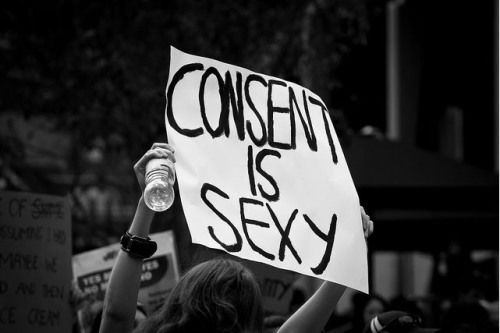
Granted, I haven’t been a teenager for a decade. Or maybe two. Okay. Three! But when I was a teenager, these slogans… Don’t Drink and Drive Just Say No Buckle Up It’s the Law …were not in the public consciousness. They didn’t exist. Not all slogans work to educate; but often they do. Wearing a seatbelt went from a cumbersome task to something you wouldn’t consider not doing. And while my generation, and the generation before me, thought nothing of drinking and driving, from what I can tell, young people today simply don’t. And the latest buzzword is consent. According to a New York Times article, Sex, With a Syllabus, freshman at Trinity College are required to attend lectures that are part of a sexual assault curriculum. Sex education activist Jonathan Kalin is bringing awareness to the issue. And a number of campuses have programs called, Consent is Sexy. “When it comes to young people today, and college, and hooking up, and drinking, and rape culture, and consent there is enough confusion that the services of Mr. Kalin are in high demand.” The New York Times article uses the analogy of convincing a friend to go on a roller coaster ride. What if the friend doesn’t want to go, what are you going to do to convince? And so the question is, if you go on the ride, are you giving consent? I want to say: Yes. While I’m sure this is not the intent, consent curriculum seems to revolve mostly around men asking for consent, not women. Our cultural beliefs play a part in our decision-making. Sometimes, even today, women are torn, and find themselves in precarious situations. They might be persuaded into activity because they don't want to seem harsh, withholding. Or bitchy. Drinking alcohol does not absolve us from responsibility. And men, even if persistent, in my opinion, are not responsible. In Justin Bieber’s new song, What Do You Mean? the lyrics point to a woman’s ambiguousness. Bieber sings, “What do you mean? When you nod your head yes, but you want to say no. What do you mean?” Women need to be clear. They need to exert their own power, use their voices and practice agency in stating what they want, or don’t want; and then, they need to exhibit behaviors that match. People of my generation might think consent education is superfluous because body language and participation should be good indicators of interest. But then again, we thought we didn’t need seat belts.

January 5, 2016
Last year in Israel, I shot an M16. Doing that was a big deal not only because shooting an assault rifle is a big deal, but because I was the kind of mom who wouldn’t buy my children a toy gun. I was the kid who wore peace sign T-shirts and scribbled the word peace all over my notebooks. I won’t kill an insect. But I grew up during a time of relative peace, a time when hippies spewed love and John Lennon sang Imagine. I didn’t understand until recently that conditions in the world could change, that the harmony I’d experienced my entire life, could vanish. I believed there would never be another war. How could there be? Weren’t people smarter? Hadn’t we seen enough destruction in World War II and in Vietnam? My mother used to tell me stories about the air raid drills she had to participate in during the 50's when she was a young schoolgirl, and how she was instructed to hide under her desk when an alarm rang in order to shield herself from flying glass. She always emphasized the fear, the uncertainty, she felt. I thought those stories to be antiquated, a thing of the past. I never had to do anything like that. But my daughter does. At her school, they practice. Students are prepared for a terrorist attack. It seems that every day now, in the newspaper and on the news, there is a new story involving guns and death. For so long, I believed we had to get rid of guns. But then one day recently, I think it was after the shooting in California, I woke up and decided I wanted to learn to shoot. I was done with my Pollyanna attitude. For the first time in my life, the world seemed like a dangerous place. It’s not that I want to hurt anyone; but I do feel a pull, a calling, to protect my family and myself. The day after I left Tel-Aviv, four days after I'd shot an M16, there was a shooting just a ten-minute walk from the hotel we stayed at. A gunman killed two innocent people and injured eight outside a bar in the middle of the day. He got away. I don’t know if I could ever really own a gun. But the fact that I, a self-proclaimed flower child, could even think about it is significant. Times are changing. People change too.
December 29, 2015
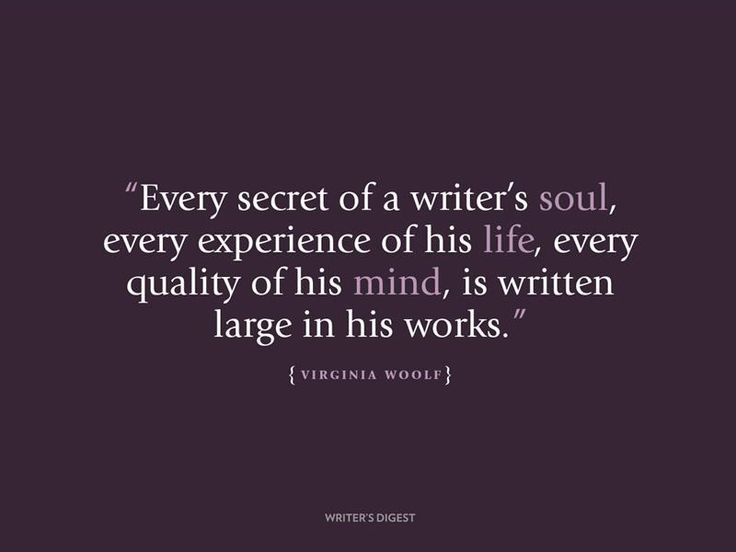
“How iPhones Ruin Your Posture and Your Mood” was a recent New York Times headline. According to the article, in order to see our small screens, we are hunching. And cowering affects our self-esteem. In, Are You Addicted to your cell phone? I discussed other disadvantages of phone use, namely being easily distracted and not focused on the present moment. And while those things may be true, here’s what’s also true— I love my cell phone! It allows me to view, Ruth Chang’s TED talk, How To Make Hard Choices. Jill Bolte Taylor’s talk, My Stroke of Insight, a fascinating discussion about the brain and peace on earth. Johann Hari: Everything You Think You Know About Addiction is Wrong. On Facebook, I see how the owners of SOTO boutique, a clothing store in LA, made their holiday party not only festive but meaningful. At a Sunday morning breakfast, packages of clothes for the homeless were arranged for distribution. What a lovely way to spend the day: amongst friends and coworkers, giving back. On Twitter, I follow Novelicious and find this Kurt Vonneget quote. And this one by Virginia Woolf. On Instagram, Alice Chera, Life coach, posts one of her thoughtful every day reminders. Once again, it boils down to what my mother says. Somehow it always boils down to what my mother says: With the good, comes the bad. So, yes, I’ve been spending more time on my phone but I’m getting a lot in return. (Like the idea that I have to pay attention to my posture.) So every now and then, I’ll remember to sit up tall. But I won’t stop reading what’s on my tiny screen—gathering information, insights, ideas and inspiration.

December 22, 2015
I agree with Martin Luther King. "Hate is too great a burden to bear." Especially for children already carrying rocks.
December 15, 2015
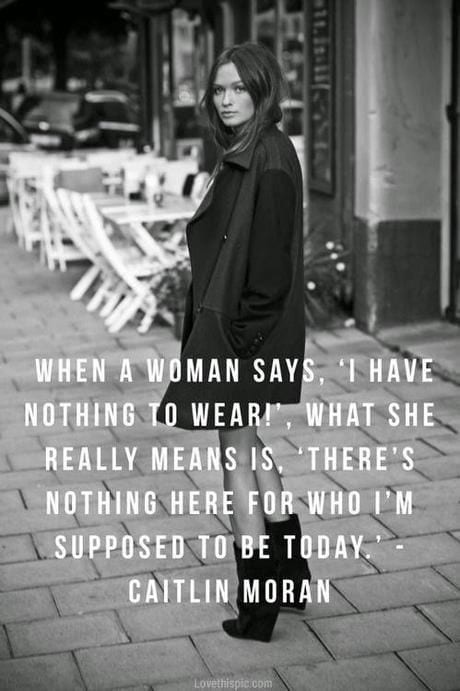
I'm slightly miserable because I have to go shopping. Truth be told, there are so many things I’d prefer to be doing. But I need clothes. And as much as I don’t like shopping, I do like having nice clothes in my closet. I wasn’t always like that. (See: Painting with Purple Crocodile and Black Leather). But now I see clothes as a creative expression of who I am; and I like being able to match my outside to my inside. And when I don’t have the right items in my closet, I can’t do that. I recently read an article that asked me to consider what my clothes conveyed about me. Do you dress to impress (a boss, a love interest, a friend)? Do you dress in a way that objectifies you? Do you dress in the same old, tired, clothes that might not express who you are today? (This last one is unfortunate because I like to think that over the last five years, I was ahead of the times in wearing flare jeans, feather earrings and fringe purses. But my daughters are quick to tell me, this was not the case. In any event, for now, those things are back in style! Not tired and out of date at all.) Things to do: Go through your closet. 2. Throw away, or give away, what’s not working for you. 3. If you haven’t gone shopping in a long time, GO. 4. Remember: What you wear reveals how you feel about yourself. BLOG-FASHION QUOTE

December 8, 2015
In 1984, I flew to Europe in a no-smoking seat. The row in front of me was a smoking row. That’s how it was then— preposterous! I was three months pregnant and allergic to cigarette smoke. The plane ride was a torturous eight hours as the man in front of me lit up every thirty minutes. While government has been slow to respond to the dangers of cigarettes, smoking was banned on all U.S. domestic flights in 1990. And in 1995, Delta made all flights, including international flights, smoke-free. On New York City streets, I run around, and in front of, people who are smoking. Not wanting to breathe secondhand smoke, I sprint past buildings where workers congregate, smoking. And what makes this running around extra-annoying is that smokers seem oblivious to the discomfort they cause. Fortunately, the law has gotten involved. And while Michael Bloomberg’s initiative to ban smoking in bars and restaurants was met with much resistance, it has been successful. According to statistics, smoking in New York is down, and the city, and its restaurants and bars, seem to be thriving and doing just fine without the smoke-filled haze. While Bloomberg was in office, he proposed a law to force residential buildings to develop smoking policies. He wanted buyers and tenants to be made aware of smoking regulations. Unfortunately for me, the law did not pass. I learned the hard way about noise due to construction in the city a few years back when I rented an apartment. But I truly thought it was me alone who experienced such terrible luck. How was it possible for one individual to be surrounded by so much noise? (See: On Writing and Distractions.) There is a Yiddish folktale: It Could Always Be Worse. But with the three apartments surrounding mine under construction, and one above me, I did not believe that could possibly be true. But it was true. A few months ago I signed a one-year lease on a New York City apartment. And in this new apartment the problem is much worse. My neighbor is a chain-smoker and her secondhand smoke seeps into my apartment making it difficult to breathe. The hallway carpeting reeks. (Read this upsetting article about third hand smoke.) Neighbors on all sides are incensed. But there is nothing we can do. Our building does not have smoking restrictions. And us non-smokers have no rights, even though our health is at stake, our quality of life is compromised, and smoking is ranked second in causes for New York fires. I don’t know how I didn’t notice the repulsive smell when I went to view the apartment. But I didn’t and the real estate agent didn’t point it out to me. Legally, she’s bound to mention bed bugs. To make matters worse, my neighbor is an eighty-year old woman. She has been smoking for decades. And even if we (me and my neighbors) had the right, we wouldn’t evict an old lady. We are stuck. So often as a non-smoker, I've felt trapped, without choice, powerless. So I was happy to discover that there are new smoking laws that protect children. In England, you may not smoke in a private vehicle carrying children under 18. In Italy, there is a ban on smoking in cars carrying pregnant woman and children. In France, smoking was barred in July 2015 for children under 12. In the United States, smoking with kids in the car is banned in eight states and the age of the child varies from state to state. These laws do not apply to e-cigarettes or convertibles with the top down. One day, soon I hope, in the same way we came to understand the importance of legislation demanding the use of seatbelts and helmets, and laws prohibiting drinking and driving, we will come to realize the obligation we have to protect non-smokers. We will look back on this time in our history and wonder why we allowed smokers to subject non-smokers to pollutants that are known to affect health, cause cancer. Could it get any worse?
December 1, 2015
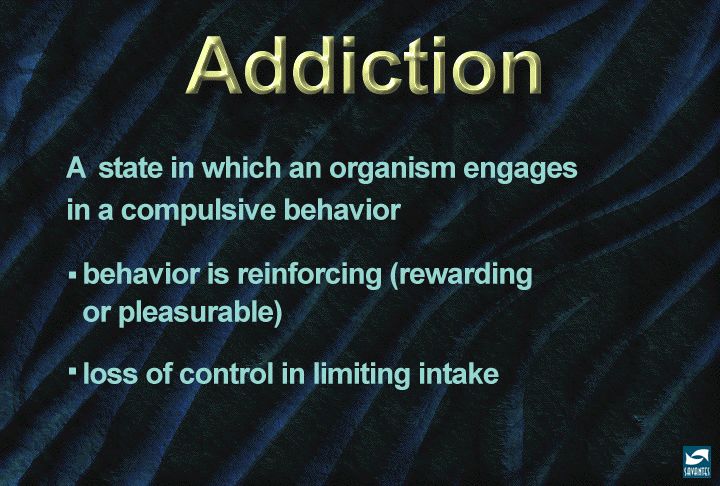
My daughter caught me scrolling through facebook and said, “You’re not just doing that for work.” She was calling me out on what I’d been telling her, which was that I needed to be on facebook and instagram and twitter in order to stay in “the know”. It was how authors promoted their books. It was where I could announce my new literary agent, Carrie Howland from Donadio and Olson! It was where I found interesting articles and learned about communicating in a social media world, which felt as natural to me as raising a baby whale. I needed information! But all this was relatively new. I joined facebook, instagram and twitter only 18 months ago. I did that for two reasons. One, I wanted to promote my new blog; and two, I didn’t want to be left behind. I wanted to know what was going on around the globe, and I wanted to be a part of it. Simultaneously, everyone in my family complained, bitterly, how I never answered my phone. And that was because I could leave it untouched for hours at a time while I wrote. So over these 18 months, I became more connected and reliant. And little by little, something changed. (Read: Be Here Now.) Just this weekend, I’d been wondering if I’d crossed some invisible line because last week, on vacation, in a first attempt to boost my numbers, I studied those social media sites for long periods of time when I was supposed to be relaxing on a beach. It was my first vacation completely connected. Before that friends teased me because I couldn’t manage to get my phone to work once I left the country. And of course, the truth behind that was I didn’t want a working phone. Now that scenario seemed impossible, ridiculous, archaic. So when my daughter called me on my behavior, it solidified what I’d been contemplating. I had to pay attention to what I was doing. “I’m going to read,” I said. And I went upstairs. Alone in my room, I checked my wordpress numbers and read some email messages. Before I knew it, I was hooked and kept scrolling. Just a few minutes more I kept telling myself, my daughter’s voice in my head. I stumbled on Oprah's SuperSoul Sessions. I was elated! I thought about how as a child, I got bored. But now, as an adult, with all this access, how could I ever get bored? There was so much to see; I couldn’t keep up. The SuperSoul speaker was Elizabeth Gilbert. And she was speaking to a huge audience about passion and curiosity and I clung to every word with guilty pleasure. I told myself again and again, rationalizing, that I could’ve paid for seats in that audience and her talk would’ve felt like a cultural outing, something special. Elizabeth’s speech was empowering and informative and yet as I watched her on my I-phone, I watched the clock intently aware that I was missing precious reading time. I’d been in my room for close to an hour, my book, unopened, at my side. And here’s what happened: I wanted to watch another SuperSoul Session but didn’t. I was intent on reading. And worried that the Internet had control of me, I made sure to read. It was a bargain, kind of like how an alcoholic decides he doesn’t have a drinking problem if he can go without alcohol for two days. The trouble was, I didn’t get into the shower when I was supposed to, and running late, decided not to go out. My Internet distraction, just like any addiction, had an impact. There are so many possibilities of how my evening could’ve unfolded. Maybe my daughter and I would’ve had a meaningful conversation. Maybe I would’ve read more pages. I definitely would’ve showered when I was supposed to and then my night would’ve taken a different direction. Instead of staying home, I could’ve gone to a jazz club and heard live music. I could’ve gone to a movie in an actual theater and not watched the stupid one I rented at home. It’s not that any of these activities were necessarily bad, because I really did appreciate the Gilbert talk; it was just that they all felt a bit out of my control. And while I had a nagging feeling that I was tipping into new territory over the last few weeks, I kept pushing the thought away, denying, and or defending my choice to send a text, answer an email, post a comment. As if any of these were actually choices. The word addiction kept popping into my head. Was I addicted? That’s ridiculous, I told myself. Just 18 months before I didn’t even have a facebook friend. But if addiction is a relentless and compulsive pull to a substance, or activity, and interferes with everyday life, I (shockingly) was guilty of that. And then I woke up to the NY Times article: Addicted to Distraction and everything I’d been feeling was laid out in front of me. I related to Tony Schwartz’s experiences wholeheartedly. And yet, and maybe this is denial, I had questions. Schwartz wrote about being less focused because of the amount of time he spent online. I had been noticing the same thing. He stated that reading was a focus building practice. And he wanted, like I did, to do that more. So instinctively, I agreed with him. But why? Why was reading a better choice? Was that thinking outdated? Maybe that's the equivalent of insisting we use horses for transportation. Horses are naturally more beautiful than cars and they don't have us relying on foreign countries for oil. In addition, cars go too fast and, as a result, we miss a lot. According to Nicholas Carr, “We willingly accept the loss of concentration and focus, the division of our attention and the fragmentation of our thoughts, in return for the wealth of compelling or at least diverting information.” We make trade-offs. And that’s why we drive cars instead of horses. In time, problems get addressed and voila—the electric car is on the frontier. Tony Schwartz gives suggestions on how to limit the amount of time you spend on your phone, and in fact, I was ahead of him in that I had my phone far away from me, on purpose, as I read the newspaper Sunday morning. But these are short-lived solutions. This doesn’t really address the problem. If there is a problem. Maybe things are the way they are supposed to be. Maybe trying to stay off our devices is a pointless fight against change and modernization. But in the last few paragraphs of Schwartz’s article, he gets me. He depicts a scene. He recounts how he saw a father and his four-year-old daughter at a restaurant. The father is on his phone and his daughter cannot get his attention. In my opinion, this scenario illustrates our biggest loss. I’ll bet that father wouldn’t dream of bringing a book to the restaurant. It would be socially awkward and unacceptable. But his phone—no problem. I’d like to say there is a time and a place for everything (because that’s what my mother would say) but when something is compulsive, it is compulsive. There are no boundaries. We are scrolling ourselves into oblivion and the key here, and what makes these behaviors, or advancements, different than others, is its addictive component. We are in denial (Denial= Don't Even Notice I Am Lying) or at least I was until my daughter finally got my attention.
November 24, 2015
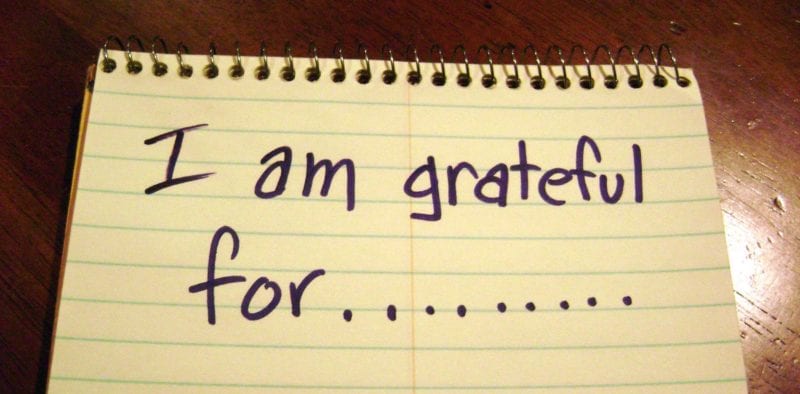
According to Arthur Brooks, a contributing opinion writer at the New York Times, acting grateful can actually make you grateful. And I’m a believer. I’ve always been one to see the bright side. If I have to wait in a doctor’s office for thirty minutes, I’m grateful it wasn’t forty. In a hotel, if my room isn’t great, I’m grateful to be on vacation at all. I never thought about why I functioned that way but in the article Choose to Be Grateful. It Will Make You Happier, Brooks states there is a gene associated with gratitude. But for those less inclined, there are things to be done. Practice the AA slogan... Because faking it til you make it works. Positive thinking affects our brain — and our mood. Keep a Gratitude Journal. Every night before bed, jot down five things you are grateful for. These don’t have to be big things. In fact, I'm genuinely appreciative when the television show I wanted to watch was recorded. And of course, I am thankful for the big things too. As I get older, I’m seriously grateful for the privilege of simply waking up each morning. If you don’t want to write things down, just take the time to acknowledge them as Brooks suggests, with interior gratitude, giving thanks privately. Eventually, you may try exterior, or public, gratitude. Over this last year, blog entries I’ve written about Mother’s Day (Are You Turning Into Your Mother?), Father’s Day (What My Father Gave Me) and Halloween (Halloween Costumes: Why They Matter) appeared after the actual day. I’m grateful, and totally happy, that I finally got a holiday post out BEFORE the holiday! Happy Thanksgiving!!